This engagement opened on May 28, 2026 and closed on August 27, 2026.
Engagement purpose
The Government of Canada is reviewing its Geographical Indications (GI) regime to see if it should be expanded to include new types of products, such as crafts and industrial goods.
We also want to understand how these changes could affect Indigenous knowledge, cultural expressions, and the use of Indigenous place names.
We invited producers, consumers, communities, and Indigenous Peoples to share their views. Your feedback will help guide future decisions about Canada’s GI system.
1. WHO WE ENGAGED
The government welcomed the perspectives of all Canadians interested in matters related to GIs and their expansion.
Canadians were invited to submit their feedback through the engagement questions. In addition, the government held targeted roundtables, including with Indigenous partners and subject-matter experts.
2. INDIGENOUS ENGAGEMENT
A dedicated Indigenous engagement process is a key part of this initiative.
Consistent with the United Nations Declaration on the Rights of Indigenous Peoples Act (UNDA) and its Action Plan, particularly measure 101 (APM 101), the Government of Canada is committed to working in cooperation with Indigenous Peoples to ensure appropriate measures are in place for them to maintain, control, protect and develop their cultural heritage, traditional knowledge and traditional cultural expressions.
This engagement:
explored potential impacts on Indigenous knowledge, cultural expressions and place names
identified approaches that reflect Indigenous rights, interests and priorities
This engagement did not assume that GIs are the precise or only tool to address the full extent of needs of Indigenous Peoples with respect to protecting their IP. Rather, it sought input on how and if GIs could complement other approaches to maintain, control, protect and develop Indigenous knowledge and cultural expressions.
3. ENGAGEMENT PAPER
The key topics are outlined in the Review of Canada’s Geographical Indications Regime Engagement Paper.
4. BACKGROUND
Geographical Indications (GIs) are a form of IP that acts as source and quality indicators, signaling to consumers that a product is from a certain geographic region, and has a reputation, quality, and/or other characteristics that are essentially attributable to the region. GIs are governed by the Trademarks Act.
Currently, Canada’s GI regime is limited to certain categories of agricultural products, foods, wines and spirits. While some GIs have been protected in Canada, uptake has been limited compared to trademarks or other forms of IP.
Many jurisdictions around the world have expanded their own GI regimes to include non-agricultural products, such as crafts and industrial products. This often helps support domestic economic development and international trade, particularly in rural areas.
5. REPORT AND NEXT STEPS
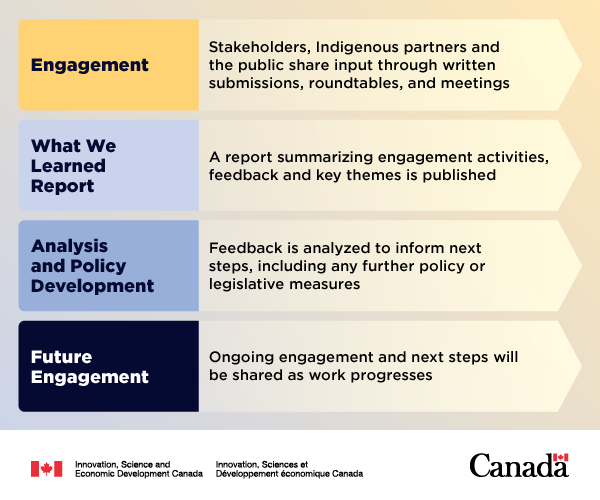
The government will publish a summary of the engagement activities. This input will inform next steps, including whether further policy or legislative measures should be explored.
6. ENGAGEMENT PROCESS
⚠
Current status: Closed for input
This engagement opened on May 28, 2026 and closed on August 27, 2026.
Engagement purpose
The Government of Canada is reviewing its Geographical Indications (GI) regime to see if it should be expanded to include new types of products, such as crafts and industrial goods.
We also want to understand how these changes could affect Indigenous knowledge, cultural expressions, and the use of Indigenous place names.
We invited producers, consumers, communities, and Indigenous Peoples to share their views. Your feedback will help guide future decisions about Canada’s GI system.
1. WHO WE ENGAGED
The government welcomed the perspectives of all Canadians interested in matters related to GIs and their expansion.
Canadians were invited to submit their feedback through the engagement questions. In addition, the government held targeted roundtables, including with Indigenous partners and subject-matter experts.
2. INDIGENOUS ENGAGEMENT
A dedicated Indigenous engagement process is a key part of this initiative.
Consistent with the United Nations Declaration on the Rights of Indigenous Peoples Act (UNDA) and its Action Plan, particularly measure 101 (APM 101), the Government of Canada is committed to working in cooperation with Indigenous Peoples to ensure appropriate measures are in place for them to maintain, control, protect and develop their cultural heritage, traditional knowledge and traditional cultural expressions.
This engagement:
explored potential impacts on Indigenous knowledge, cultural expressions and place names
identified approaches that reflect Indigenous rights, interests and priorities
This engagement did not assume that GIs are the precise or only tool to address the full extent of needs of Indigenous Peoples with respect to protecting their IP. Rather, it sought input on how and if GIs could complement other approaches to maintain, control, protect and develop Indigenous knowledge and cultural expressions.
3. ENGAGEMENT PAPER
The key topics are outlined in the Review of Canada’s Geographical Indications Regime Engagement Paper.
4. BACKGROUND
Geographical Indications (GIs) are a form of IP that acts as source and quality indicators, signaling to consumers that a product is from a certain geographic region, and has a reputation, quality, and/or other characteristics that are essentially attributable to the region. GIs are governed by the Trademarks Act.
Currently, Canada’s GI regime is limited to certain categories of agricultural products, foods, wines and spirits. While some GIs have been protected in Canada, uptake has been limited compared to trademarks or other forms of IP.
Many jurisdictions around the world have expanded their own GI regimes to include non-agricultural products, such as crafts and industrial products. This often helps support domestic economic development and international trade, particularly in rural areas.
5. REPORT AND NEXT STEPS
The government will publish a summary of the engagement activities. This input will inform next steps, including whether further policy or legislative measures should be explored.